Scenario card: open-area-10ghz
Open area with hexagonal sites, nothing tied to place
Available since version 0.2.0. Use it as scenario: open-area-10ghz in a configuration file or hl.builtin_scenario("open-area-10ghz") in Python.
Purpose
The counterpart of urban-grid-10ghz without buildings: the same rectangle, sites on a hexagonal grid with 100 m spacing, the LOS state of TR 38.901 drawn as a process along each user's own path and all shadowing moving with the user (place_share = 0). Nothing repeats by place, so a rule that learns from places should gain nothing here. Users move between random waypoints.
Layout
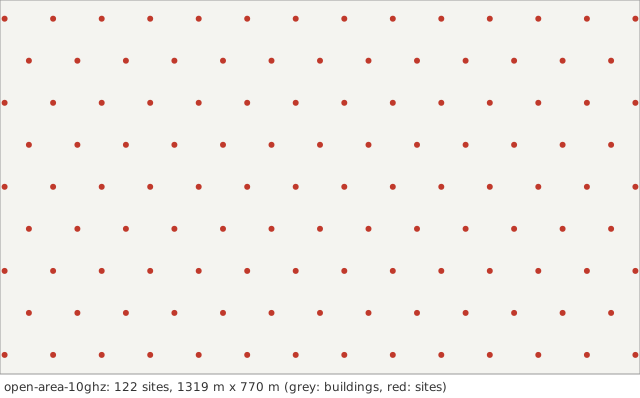
The 1319 m x 770 m rectangle of the 3 x 3 grid without buildings; hexagonal site grid.
Parameters
Values in bold differ from the HandoverLab defaults.
| Key | Value | Source |
|---|---|---|
layout.kind |
open_area | assumption (open area, hexagonal sites) |
layout.blocks |
[3, 3] | TR 37.885 Table A-1 (minimum 3 x 3 blocks) |
layout.pitch_m |
[433, 250] | TR 37.885 Annex A (433 m x 250 m) |
layout.street_width_m |
20 | TR 37.885 Annex A (20 m) |
layout.site_spacing_m |
100 | assumption (hexagonal spacing) |
layout.sites |
none | regular placement along the streets |
radio.carrier_ghz |
10 | assumption (upper mid-band, 7-24 GHz) |
radio.bandwidth_mhz |
200 | assumption |
radio.tx_power_dbm |
35 | assumption (small cell; TR 37.885 Table 6.1.1-2 has 43 dBm for its macro sites) |
radio.bs_gain_db |
20 | assumption (beam gain, no beam management) |
radio.ue_gain_db |
0 | assumption |
radio.noise_figure_db |
7 | assumption (typical UE noise figure) |
radio.isolation |
0.3 | assumption (mean-to-peak gain of an interfering data beam) |
radio.bs_height_m |
10 | TR 38.901 Table 7.4.1-1 (UMi: 10 m) |
radio.ue_height_m |
1.5 | ITU-R M.2412-0 Table 5 (outdoor UEs: 1.5 m), within 1.5-22.5 m of TR 38.901 Table 7.4.1-1 |
radio.pathloss |
umi_street_canyon | TR 38.901 Table 7.4.1-1 |
radio.shadow_los_db |
4 | TR 38.901 Table 7.4.1-1 (UMi and UMa LOS: 4 dB) |
radio.shadow_nlos_db |
7.82 | TR 38.901 Table 7.4.1-1 (UMi NLOS: 7.82 dB) |
radio.shadow_decorr_m |
10 | TR 38.901 Table 7.5-6 Part-1 (UMi: 10 m LOS, 13 m NLOS; the LOS value is used for both, see the limitations) |
radio.place_share |
0 | assumption (no place-tied shadowing) |
radio.los_corr_m |
50 | TR 38.901 Table 7.6.3.1-2 (LOS/NLOS state, UMi and UMa: 50 m) |
radio.time_var_db |
1.5 | assumption (moving blockers) |
radio.time_var_tau_s |
1 | assumption |
radio.l1_error_db |
1 | assumption (error of one L1 RSRP sample) |
radio.penetration_db |
0 | off by default; TR 38.901 clause 7.4.3.2: 9 dB in a standard car |
radio.penetration_sd_db |
0 | off by default; TR 38.901 clause 7.4.3.2: 5 dB in a standard car |
radio.energy_p0_w |
56 | EARTH model, micro base station (Auer et al. 2011, Table 2): 56 W |
radio.energy_slope |
2.6 | EARTH model, micro base station (Auer et al. 2011, Table 2): 2.6 |
radio.map_res_m |
1 | numerical setting |
protocol.step_s |
0.01 | numerical setting |
protocol.l1_period_s |
0.04 | assumption (L1 sample period) |
protocol.l3_k |
4 | TS 38.331 clause 5.5.3.2 |
protocol.label_period_s |
0.2 | numerical setting |
protocol.report_interval_s |
0.12 | TS 38.331 reportInterval (ms120) |
protocol.qout_db |
-8 | TR 36.839 (Qout -8 dB) |
protocol.qin_db |
-6 | TR 36.839 (Qin -6 dB) |
protocol.qout_window_s |
0.2 | TS 38.133 (evaluation period, 200 ms) |
protocol.qin_window_s |
0.1 | TS 38.133 (evaluation period, 100 ms) |
protocol.n310 |
1 | TR 36.839 |
protocol.n311 |
1 | TR 36.839 |
protocol.t310_s |
1 | TR 36.839 (1 s) |
protocol.prep_s |
0.05 | TR 36.839 (50 ms) |
protocol.exec_s |
0.04 | TR 36.839 (40 ms) |
protocol.reest_s |
1 | assumption (1 s outage); TS 38.133 6.2.1.2.1 bounds the delay by 50 ms + cell identification (FR1: 200 ms known, 800 ms unknown cell, Table 6.2.1.2.1-1) + system information + PRACH; TR 36.842 Table E.1-2 uses 250 ms |
protocol.cho_recovery_s |
0.4 | TS 38.300 clauses 9.2.3.1 and 9.2.7 (recovery into a CHO candidate; assumption 0.4 s) |
protocol.pingpong_s |
1 | TR 36.839 (minimum time of stay, 1 s) |
protocol.cfg_loss_as_failure |
false | check mode only |
protocol.lm_load |
none | off by default: link monitoring sees the load of the data channel (calibration option) |
protocol.lm_load_per_ue |
0 | off by default (calibration option) |
protocol.exec_can_fail |
true | TR 36.839: the execution fails when the target is below Qout |
protocol.rlm_holdoff_s |
0.2 | 0.2 s since 2.0.0: an interpretation of TS 38.133 8.1.2.2 (evaluation over the last T_Evaluate_out, 200 ms in FR1) on a newly joined cell |
traffic.services |
5 entries | TS 23.501 Table 5.7.4-1 (5QI); thresholds are assumptions |
traffic.se_max |
7.4 | assumption (spectral-efficiency cap) |
traffic.hotspot_share |
0.25 | assumption |
traffic.hotspot_load |
[0.55, 0.85] | assumption |
traffic.normal_load |
[0.05, 0.25] | assumption |
traffic.load_tau_s |
0.2 | assumption |
traffic.rate_scale |
1 | assumption |
traffic.label_load |
1 | assumption (all cells transmit for the label) |
traffic.model |
fixed | fixed: constant service rates (the model of 1.0) |
traffic.period_s |
0.02 | periodic model: 20 ms, as VoIP |
traffic.packet_bytes |
100 | periodic model: assumption |
traffic.ftp_file_bytes |
500000 | FTP model 3 (TR 36.872 Annex A.1) with 0.5 Mbyte files (TR 38.802 Table A.2.1-1; TR 38.821 Table 6.1.1.1-7) |
traffic.ftp_rate_hz |
0.1 | ftp3 model: assumption (file arrival rate per user) |
mobility.users |
40 | assumption |
mobility.profile |
v60 | random waypoints at vehicular speed (assumption) |
mobility.groups |
none | profile |
run.duration_s |
120 | numerical setting |
run.warmup_s |
20 | numerical setting |
Not read by this layout and radio model, so not listed: layout.site_offset_m, radio.clutter_los, radio.shadow_site_corr.
Known limitations
- No minimum distance to the sites: users may pass closer than the 10 m of TR 38.901 Table 7.2-1 (UMi); the path loss is evaluated at 10 m there (since 2.0.0).
- The LOS state follows the TR 38.901 LOS probability with the UMi street-canyon formula although there are no streets; it stands for scattered obstacles.
- Random-waypoint users cross the area in straight lines; their density is higher in the middle.
- Same received-power-level abstraction and uncalibrated failure model as the street grid.
- One shadowing decorrelation distance, the UMi LOS value of 10 m, also for the NLOS links (TR 38.901 Table 7.5-6 Part-1: UMi LOS 10 m, NLOS 13 m); LOS and NLOS links share one unit shadowing realisation scaled by the LOS or NLOS standard deviation (TR 38.901 gives separate LOS and NLOS parameters).
- The UE antenna is the 1.5 m of the outdoor UEs of ITU-R M.2412-0, not the 1.6 m of TR 37.885 vehicle type 2: the random-waypoint users of this card follow no TR 37.885 mobility model.
Reference results
- Determinism and invariant checks; the open-area golden fingerprint of
handoverlab verifyuses the 2 x 2 rectangle.