How to study handover with a LEO satellite (NTN)
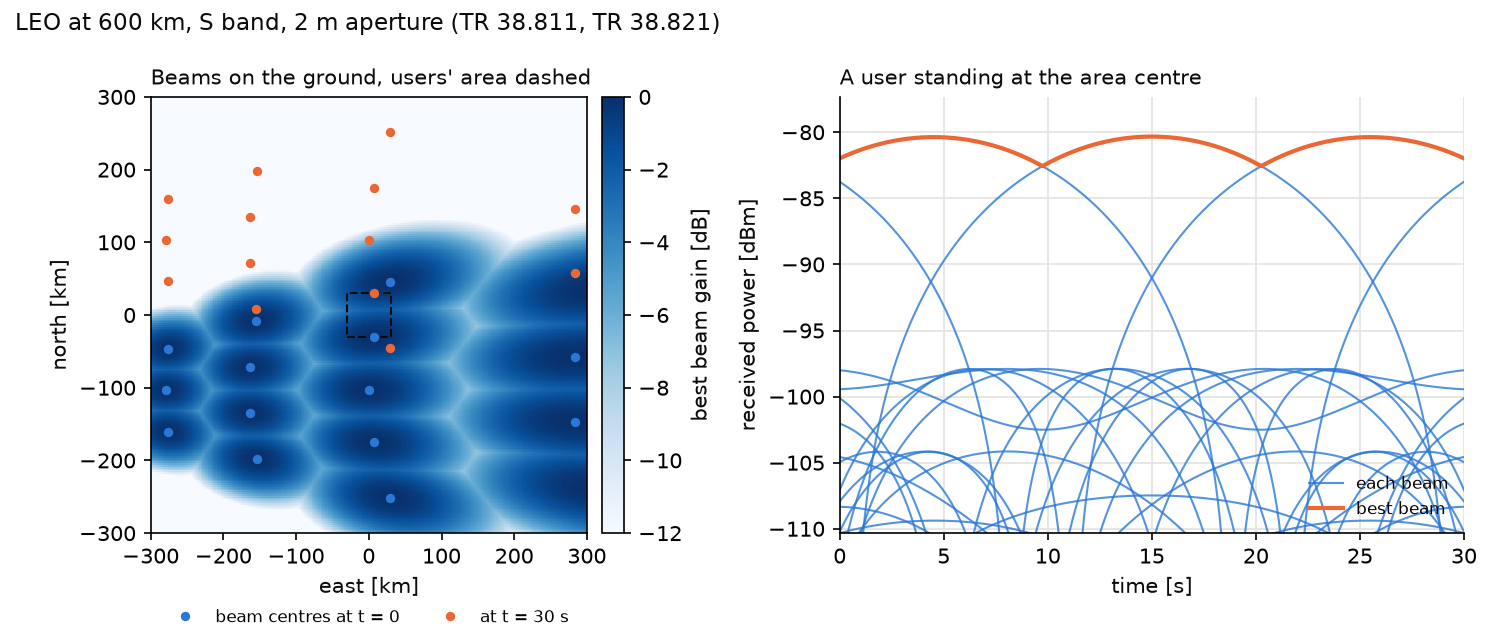
Since 2.0.0 HandoverLab simulates one LEO satellite with earth-moving beams: layout.kind: ntn, the
scenario card ntn-leo600-2ghz and the rule cho_d2 (conditional handover
with the location condition D2 of Release 18). The model follows the 3GPP NTN study:
| Part | Source |
|---|---|
Earth as a sphere of 6371 km, satellite antenna 4 |J1(ka sin t)/(ka sin t)|^2 |
TR 38.811 V15.4.0 clauses 6.3, 6.4.1 |
LOS probability per elevation (ntn.los_model: probability, the value of the nearest reference elevation, as clause 6.6.1 prescribes), PLb = FSPL + SF + CL, slant range, shadowing and clutter tables, atmospheric loss Azenith / sin(alpha) |
TR 38.811 Table 6.6.1-1, Eqs. 6.6-2..6.6-4, Tables 6.6.2-1..3, Eq. 6.6-8 |
Baseline propagation condition of the system-level simulations, "Clear Sky, Line of sight" (ntn.los_model: los, since 2.1.0; used by the card) |
TR 38.821 Tables 6.1.1.1-5, 6.1.1.1-7 |
| LEO-600 Set-1 S band (2 m aperture, 3 dB beamwidth 4.4127 degrees, 34 dBW/MHz), handheld UE (0 dBi, NF 7 dB), 19 beams on the UV plane spaced sqrt(3) sin(HPBW / 2) from the tabled beamwidth (since 2.1.0), reuse 1 | TR 38.821 V16.2.0 Tables 6.1.1.1-1, -3, -4, -5 |
| 7.56 km/s, round-trip delay 25.77 ms (transparent LEO, scenario C2) | TR 38.821 Table 7.1-1 |
| CondEvent D2 (moving reference locations), combined with A3 | TS 38.331 V18 5.5.4.15a and CondReconfigToAddMod |
All beams belong to one satellite, so a user sees them over one path: slant range, LOS state, shadowing, clutter, atmospheric and scintillation loss are common, only the antenna gain differs between beams. The beams are fixed in the satellite frame and sweep over the ground with it (scenarios C2 and D2, which RAN2 prioritised for mobility, TR 38.821 clause 7.3.2.4); a user crosses a beam every few seconds even when it stands still.
1. Run it
schema: 1
scenario: ntn-leo600-2ghz
seeds: [1, 2, 3]
rules:
  - {rule: a3, off_db: 3.0, ttt_s: 0.16}
  - {rule: cho, o_prep_db: -2.0, o_exec_db: 3.0, ttt_exec_s: 0.08}
  - {rule: cho_d2, d_thresh1_m: 25000, d_thresh2_m: 25000, hys_m: 1000}
output: results/ntn.csv
The ntn section holds the satellite (altitude_km, aperture_m, eirp_dbw_per_mhz, n_beams,
centre_elevation_deg, environment, atm_zenith_db, scintillation_db, sf_corr_m, los_corr_m, and
since 2.1.0 hpbw_deg and los_model); the card names the source of every value. hpbw_deg unset takes the
3 dB beamwidth of TR 38.821 Tables 6.1.1.1-1/-2 for the aperture (4.4127 degrees for 2 m, 8.8320 degrees for
1 m at 2 GHz), as Table 6.1.1.1-4 asks ("Only the 3dB beam width parameters should be used"), and scales the
Bessel pattern to it; with radio.channel_detail: simple the width comes from the aperture, as in 2.0.0.
scintillation_db (2.2 dB) is the link-budget margin of Table 6.1.3.2-1 (note 1: 1 % of the time) applied to
every link; the calibration of Table 6.1.1.1-5 (note 2) sets it to zero. ctx.cell_center(t) gives a rule the beam centres on the ground at time
t, the moving reference locations of Event D2.
2. What verify --only ntn checks
The criteria were fixed before the first run:
| Check | Result |
|---|---|
| N1: slant range, free-space loss, atmospheric loss and CNR of the 8 S-band LEO cases of TR 38.821 Table 6.1.3.3-1 within 0.1 dB | passed: largest difference 0.028 dB |
| N2 (since 2.1.0): the beams have the tabled 3 dB beamwidth of Tables 6.1.1.1-1/-2 for the apertures 2 m and 1 m, the pattern scaled to it has that width within 0.0001 degree, and the beam spacing is within 0.0002 of the informative values 0.0668 and 0.1334 of Table 6.1.1.1-6 | passed: spacing 0.06668 and 0.13336. Until 2.0.0 the width came from the aperture and N2 failed for 1 m (8.8462 against 8.8320 degrees; 2 m: 4.4198 against 4.4127, both 0.16 % wider) |
| N3: orbital speed at 600 km within 0.5 % of 7.56 km/s, nadir footprint within 10 % of 50 km | passed: 7562 m/s, 46.2 km (46.3 km with the beamwidth of the aperture, until 2.0.0) |
3. What to expect, and what is not modelled
- With A3 (3 dB, 160 ms) a user completes about 4.7 handovers and has 1.34 link failures per minute in the check run of 2.0.0 (seed 1, LOS probability of TR 38.811); together they match the 5.7 beam changes per minute of the sweep (beam centres 72 km apart along the track, passed at about 6.85 km/s on the ground).
- Frequency reuse 1 (option 1 of TR 38.821) makes the beam edges interference-limited: most link failures are coverage failures, where no beam is good enough. Reuse 3 or 2 (options 2 and 3) are not modelled yet.
- The default distance thresholds of
cho_d2(25 km) are half the 50 km nadir beam diameter of TR 38.821 Table 6.1.1.1-1; TS 38.331 gives no default. A first guess of 20/15 km was replaced after a first run had been seen (it gave 3.8 failures per user-minute); no further tuning was done. - Not modelled: condEventT1, earth-fixed beams, several satellites, the feeder link, Doppler, the Ka band, the user's own round-trip delay (the worst case of C2 is used for every user), and the two tiers of wrap-around beams that TR 38.821 clause 6.1.1.1 adds around the 19 beams for frequency reuse 1.
- The card points the central beam at 30 degrees elevation (case 2 of Table 6.1.1.1-4, the LEO target of the link budget, Table 6.1.3.2-1); the system-level baseline of Table 6.1.1.1-6 for C2/D2 is nadir (90 degrees).
- Shadowing (and, with
los_model: probability, the LOS state) varies with the user's own displacement only; TR 38.811 clause 6.5.1 considers drop-based simulations only, so the change of the line of sight with the moving satellite has no specified effect on them.