How to simulate SSB beams, beam failure recovery and several carriers
Since 1.10.0 HandoverLab has two optional radio models for beyond-5G studies: SSB beams per
sector with beam management and beam failure recovery (radio.beams), and several carriers
with inter-frequency measurements in gaps (radio.layers). Both are off by default; without them
every result of 1.x is unchanged. The clause-by-clause status is in
standard compliance.
1. SSB beams in FR2
schema: 1
scenario:
  base: urban-grid-28ghz-beams       # 28 GHz, 3 sectors x 8 SSB beams per site
  mobility: {users: 20}
  run: {duration_s: 80.0, warmup_s: 20.0}
seeds: [1, 2]
rules:
  - {rule: a3}
  - {rule: cho}
  - {rule: ltm}
  - {rule: cltm}
output: results/beams.csv
What happens in a run:
- Every site has
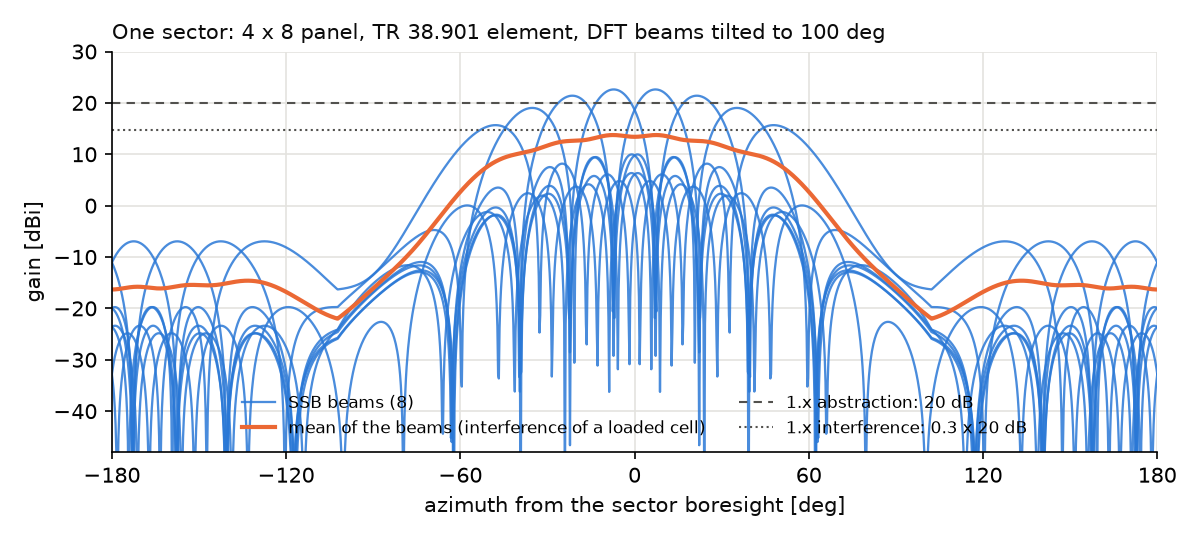
sectorscells; each cell sendsn_ssbSSB beams. The UE measures every beam (SS-RSRP per resource element with an L1 error per beam); the cell quality is the best beam or, withssb_avgandssb_thresh_dbm, the average of the best beams above the threshold (TS 38.331 5.5.3.3). Handover rules see these cell values, as before. - The gNB serves the UE on one beam (its TCI state) and moves it to a better beam after the
periodic L1-RSRP reports (
report_s,switch_db,tci_delay_s). In FR2 the L1-RSRP period of TS 38.133 includes the receive-beam sweeping factor N = 8, so the beam follows a fast user late. - If the serving beam's quality, averaged over the beam-failure-detection period (FR2: 800 ms at a
20 ms SSB period), is below Qout_LR (since 2.1.0 4 dB above Qout, as TS 38.133 Tables 8.5.2.1-1 and
8.1.2.1-1 define the two hypothetical PDCCH at 0 dB and +4 dB), the UE counts beam failure instances;
bfi_maxof them within the detection timer start beam failure recovery by random access on the best candidate beam. A recovery whose random access failspreamble_maxtimes is a radio-link failure. - The new metrics
beam_switches_pm,beam_failures_pm,beam_recoveries_pm,beam_recovery_failures_pmandbeam_recovery_s_pmcount all this; the event log and the failure metrics are those of 1.x (a failed recovery is a radio-link failure). The procedure trace (--event-level full) has the eventsbeam_switch,beam_failure,beam_recoveredandbfr_ra_problem.
Result of this configuration (seeds 1 and 2, 20 users at about 60 km/h, 60 s measured; mean per UE-minute):
| Rule | Handovers | Failures | Beam switches | Beam failures | recovered | ended in RLF | Interruption [s] | SINR [dB] |
|---|---|---|---|---|---|---|---|---|
| A3 | 25.0 | 1.50 | 46.6 | 2.58 | 1.27 | 0.80 | 2.53 | 14.0 |
| CHO | 25.9 | 1.23 | 49.5 | 1.98 | 1.32 | 0.45 | 1.77 | 15.5 |
| LTM | 31.3 | 0.80 | 51.1 | 1.55 | 0.93 | 0.28 | 1.12 | 16.0 |
| CLTM | 31.4 | 0.75 | 50.1 | 1.38 | 0.88 | 0.25 | 1.09 | 16.4 |
Half to two thirds of the detected beam failures are recovered on another beam of the same cell; most of the rest end in a radio-link failure because no beam of the serving cell is good enough any more (the user needed a handover), a few are ended by a handover. Faster cell changes (LTM, conditional LTM) leave fewer beam failures to recover.
2. Two carriers: a macro layer and a small-cell layer
scenario:
  base: urban-grid-10ghz
  radio:
    carrier_ghz: 3.5
    bandwidth_mhz: 100.0
    pathloss: uma
    bs_height_m: 25.0
    beams: {sectors: 3, n_ssb: 8}
    layers:
      - {name: fr2, carrier_ghz: 28.0, bandwidth_mhz: 400.0, site_spacing_m: 100.0,
         pathloss: umi_street_canyon, bs_height_m: 10.0, beams: {sectors: 3, n_ssb: 8}}
  layout: {site_spacing_m: 300.0}
  protocol: {meas_periods: ts38133}
rules:
  - {rule: a3a5, off_db: 3.0, ttt_s: 0.16, a5_thresh1_dbm: -100.0, a5_thresh2_dbm: -105.0,
a5_down_thresh1_dbm: -115.0, a5_down_thresh2_dbm: -108.0}- Each layer has its own sites (or
cosited: true: the sites, LOS states and shadowing of the first layer, TR 38.901 7.6.5; since 2.1.0 such a layer cannot set its ownpathloss,los_corr_morshadow_decorr_munlessradio.channel_detailissimple). Only cells of one carrier interfere with each other. - With
meas_periods: ts38133the UE measures the other carrier only in the measurement gaps (gap_pattern, default 6 ms every 40 ms) with the inter-frequency periods of TS 38.133 9.3.5: 320 ms for an FR1 carrier and 1.6 s for an FR2 carrier. During a gap it receives no data (gap_share). - The rule
a3a5uses Event A3 within a carrier and Event A5 (serving below Thresh1 and neighbour above Thresh2, TS 38.331 5.5.4.6) towards the other carrier; set the thresholds per direction, as networks configure A5 per measurement object. A symmetric A5 with a very high Thresh1 makes the users alternate between the layers. inter_frequency_handovers_pmcounts the handovers between carriers.
The card dense-urban-2layer is the two-layer dense urban environment of ITU-R M.2412
(4 GHz macro, 30 GHz micro, 690 cells); it takes a few minutes per simulated minute.
3. Things to keep in mind
- The evaluation periods of TS 38.133 are the longest a UE may take; HandoverLab uses them as averaging time constants, which makes FR2 detection slow. Real UEs may be faster.
- Data beams are the SSB beams (no CSI-RS refinement); a loaded cell interferes with the mean of its beams. Compare rules with each other on the same worlds rather than reading absolute rates.
- A beam failure recovery that cannot find a beam above Qout ends in a radio-link failure fast
(
preamble_maxattempts ofra_attempt_s); withoutbfdthe same UE would wait for T310.