Scenario card: highway-tr37885-30ghz
The TR 37.885 highway above 6 GHz (hexagonal layout, 30 GHz, SSB beams)
Available since version 1.11.0. Use it as scenario: highway-tr37885-30ghz in a configuration file or hl.builtin_scenario("highway-tr37885-30ghz") in Python.
Purpose
The highway case of the 3GPP NR V2X evaluation (TR 37.885) as specified above 6 GHz, for the base-station-to-vehicle link: a road of 3 + 3 lanes through a hexagonal layout of 19 macro sites with 3 sectors each and an inter-site distance of 500 m, with wrap-around (TR 36.885 clause A.1.3, option 2, which TR 37.885 uses above 6 GHz), the UMa LOS path loss at 30 GHz, SSB beams of the 4 x 8 panel and every vehicle at 140 km/h. Use it for millimetre-wave handover and beam management at high speed under the 3GPP highway assumptions.
Layout
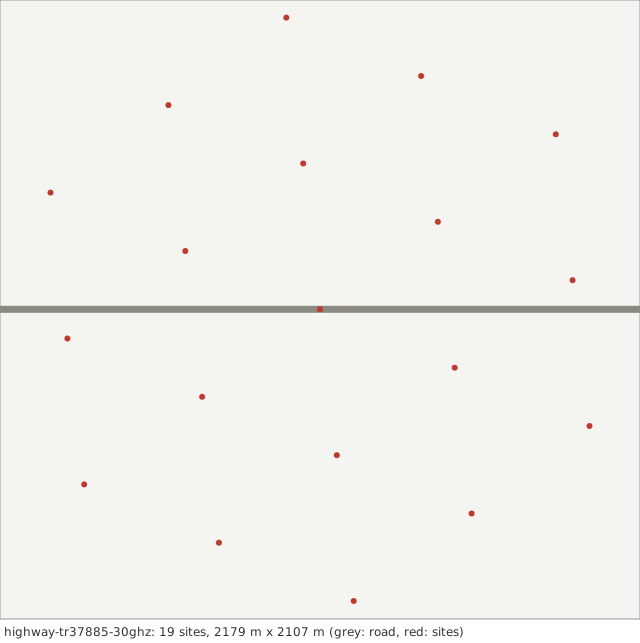
The 19 sites of two rings around a centre site, turned so that the road (24 m wide) runs along x through the centre site in the direction of the cluster translation (23.4 degrees in the frame of the hexagonal grid), as in TR 36.885 Figure A.1.3-3. The road is sqrt(19) x 500 m = 2179 m long and wraps around; distances are taken to the nearest of the seven images of every site.
Parameters
Values in bold differ from the HandoverLab defaults.
| Key | Value | Source |
|---|---|---|
layout.kind |
highway | TR 37.885 Annex A, Table A-1 (highway: 3 lanes in each direction, 4 m lane width, length >= 2000 m, wrap-around) |
layout.site_spacing_m |
500 | TR 37.885 Table 6.1.3-2 (above 6 GHz, inter macro: 500 m) |
layout.sites |
none | regular placement along the streets |
layout.lanes |
3 | TR 37.885 Table A-1 (highway: 3 lanes per direction) |
layout.lane_width_m |
4 | TR 37.885 Table A-1 (highway: 4 m lanes) |
layout.road_length_m |
2179.45 | the length of the 19-site cluster translation, sqrt(19) x 500 m, after which the road of TR 36.885 Figure A.1.3-3 repeats |
layout.sites_file |
none | none (sites from the layout) |
layout.wrap |
true | TR 37.885 Table A-1 (wrap around should be applied) |
layout.highway_sites |
hex19 | TR 37.885 Table 6.1.3-2 (above 6 GHz: BS placement as in Figure A.1.3-3 of TR 36.885) and TR 36.885 clause A.1.3, option 2 (wrap around of 19 x 3 hexagonal cells with 500 m ISD) |
radio.carrier_ghz |
30 | TR 37.885 Table 6.1.1-2 (highway, macro to/from vehicle: 30 GHz) |
radio.bandwidth_mhz |
200 | TR 37.885 Table 6.1.1-2 (simulation bandwidth 200 MHz, DL+UL) |
radio.tx_power_dbm |
43 | TR 37.885 Table 6.1.1-2 (macro BS: 43 dBm; EIRP at most 78 dBm; the system bandwidth is taken equal to the simulation bandwidth, so the PA power is not scaled down) |
radio.ue_gain_db |
11 | assumption: vehicle type 2, option 1, one rooftop panel of (1, 4, 2, 1, 4) of TR 37.885 Table 6.1.4-9 with 5 dBi elements (Table 6.1.4-8): 5 + 10 log10(4) dB |
radio.noise_figure_db |
13 | TR 37.885 Table 6.1.1-2 (UE receiver noise figure 13 dB baseline) |
radio.bs_height_m |
25 | TR 37.885 Table 6.1.4-1 (highway: 25 m for ISD 500 m) |
radio.ue_height_m |
1.6 | TR 37.885 clause 6.1.2 (vehicle type 2: antenna height 1.6 m) |
radio.pathloss |
uma | TR 37.885 Table 6.2.1-2 (highway, above 6 GHz, V2B/B2V: TR 38.901 UMa LOS); oxygen absorption, TR 38.901 Table 7.6.1-1, is 0 dB/km up to 52 GHz |
radio.shadow_los_db |
4 | TR 37.885 clause 6.2.2 and TR 38.901 Table 7.4.1-1 (UMa LOS: 4 dB) |
radio.shadow_decorr_m |
37 | TR 38.901 Table 7.5-6 Part-1 (UMa LOS: 37 m) |
radio.shadow_site_corr |
none | unset: uncorrelated between sites, TR 38.901 clause 7.5 step 4 (radio.channel_detail simple: 0.5) |
radio.place_share |
1 | assumption (blockage tied to place) |
radio.los_model |
los | TR 37.885 clause 6.2.1 (LOS propagation type is used for V2B and B2R links in the highway scenario) |
radio.breakpoint_c_mps |
3e+08 | TR 38.901 Table 7.4.1-1 notes 1 and 5 (c = 3.0e8 m/s in the breakpoint distances) |
radio.pl_min_distance_m |
10 | TR 38.901 Table 7.4.1-1 (applicability range of RMa, UMa, UMi: 10 m <= d2D) |
radio.time_var_db |
0 | set to 0: TR 37.885 has no blockage of the B2V link in the highway (LOS only) |
radio.time_var_tau_s |
1 | assumption |
radio.l1_error_db |
1 | assumption (error of one L1 RSRP sample) |
radio.penetration_db |
0 | off by default; TR 38.901 clause 7.4.3.2: 9 dB in a standard car |
radio.penetration_sd_db |
0 | off by default; TR 38.901 clause 7.4.3.2: 5 dB in a standard car |
radio.energy_p0_w |
56 | EARTH model, micro base station (Auer et al. 2011, Table 2): 56 W |
radio.energy_slope |
2.6 | EARTH model, micro base station (Auer et al. 2011, Table 2): 2.6 |
radio.energy_ntrx |
2 | EARTH model, micro base station (Auer et al. 2011, Eq. 1 and Table 2): 2 transceivers |
radio.fast_fading |
none | off by default; TR 38.901 clause 7.7.2 (TDL-A .. TDL-E) |
radio.delay_spread_ns |
100 | TR 38.901 Table 7.7.3-1 (nominal delay spread; used with fast_fading) |
radio.fading_k_db |
none | TR 38.901 clause 7.7.6 (unset: the K-factor of the table) |
radio.map_res_m |
2 | numerical setting |
radio.beams.sectors |
3 | TR 36.885 clause A.1.3, option 2 (19 x 3 hexagonal cells) |
radio.beams.sector_az0_deg |
6.587 | TR 38.901 Table 7.8-1 (3 sectors per cell site: 30, 150 and 270 degrees), turned by -23.413 degrees with the layout |
radio.beams.n_ssb |
8 | assumption (8 SSB beams per sector; TS 38.213 clause 4.1, Case D at 120 kHz, has 64 candidate SS/PBCH blocks in FR2) |
radio.beams.panel |
[4, 8] | TR 37.885 Table 6.1.4-3 (30 GHz: (M, N, P, Mg, Ng) = (4, 8, 2, 2, 2)); one panel of one polarisation per sector is modelled |
radio.beams.tilt_deg |
102 | TR 37.885 Table 6.1.4-3 (antenna tilt 102 degrees for 500 m ISD) |
radio.beams.beam_span_deg |
none | default of the beam model (user guide) |
radio.beams.ssb_avg |
none | default of the beam model (user guide) |
radio.beams.ssb_thresh_dbm |
none | default of the beam model (user guide) |
radio.beams.report_s |
0.04 | default of the beam model (user guide) |
radio.beams.switch_db |
2 | default of the beam model (user guide) |
radio.beams.tci_delay_s |
0.01 | default of the beam model (user guide) |
radio.beams.rx_sweep_n |
none | default of the beam model (user guide) |
radio.beams.bfd |
true | default of the beam model (user guide) |
radio.beams.bfi_max |
3 | default of the beam model (user guide) |
radio.beams.bfd_timer |
4 | default of the beam model (user guide) |
radio.beams.bfr_timer_s |
0.1 | default of the beam model (user guide) |
radio.beams.rsrp_thresh_ssb_dbm |
-115 | default of the beam model (user guide) |
radio.beams.ra_attempt_s |
0.01 | default of the beam model (user guide) |
radio.beams.preamble_max |
10 | default of the beam model (user guide) |
radio.beams.rlm_rs |
tci | default of the beam model (user guide) |
protocol.step_s |
0.01 | numerical setting |
protocol.l1_period_s |
0.04 | assumption (L1 sample period) |
protocol.l3_k |
4 | TS 38.331 clause 5.5.3.2 |
protocol.label_period_s |
0.2 | numerical setting |
protocol.report_interval_s |
0.12 | TS 38.331 reportInterval (ms120) |
protocol.qout_db |
-8 | TR 36.839 (Qout -8 dB) |
protocol.qin_db |
-6 | TR 36.839 (Qin -6 dB) |
protocol.qout_window_s |
0.2 | TS 38.133 (evaluation period, 200 ms) |
protocol.qin_window_s |
0.1 | TS 38.133 (evaluation period, 100 ms) |
protocol.n310 |
1 | TR 36.839 |
protocol.n311 |
1 | TR 36.839 |
protocol.t310_s |
1 | TR 36.839 (1 s) |
protocol.prep_s |
0.05 | TR 36.839 (50 ms) |
protocol.exec_s |
0.04 | TR 36.839 (40 ms) |
protocol.reest_s |
1 | assumption (1 s outage); TS 38.133 6.2.1.2.1 bounds the delay by 50 ms + cell identification (FR1: 200 ms known, 800 ms unknown cell, Table 6.2.1.2.1-1) + system information + PRACH; TR 36.842 Table E.1-2 uses 250 ms |
protocol.cho_recovery_s |
0.4 | TS 38.300 clauses 9.2.3.1 and 9.2.7 (recovery into a CHO candidate; assumption 0.4 s) |
protocol.pingpong_s |
1 | TR 36.839 (minimum time of stay, 1 s) |
protocol.cfg_loss_as_failure |
false | check mode only |
protocol.lm_load |
none | off by default: link monitoring sees the load of the data channel (calibration option) |
protocol.lm_load_per_ue |
0 | off by default (calibration option) |
protocol.exec_can_fail |
true | TR 36.839: the execution fails when the target is below Qout |
protocol.rlm_holdoff_s |
0.2 | 0.2 s since 2.0.0: an interpretation of TS 38.133 8.1.2.2 (evaluation over the last T_Evaluate_out, 200 ms in FR1) on a newly joined cell |
protocol.scheduler |
none | off by default (rate model); rr / pf slot scheduler with TS 38.214 MCS and TBS |
protocol.harq_max_tx |
4 | assumption (transmissions per TB; the network's choice) |
protocol.harq_rtt_slots |
8 | assumption (HARQ round trip in slots) |
protocol.l2s_loss_db |
1 | assumption (implementation loss of the block-error model) |
protocol.rrc_detail |
3gpp | |
traffic.services |
5 entries | TS 23.501 Table 5.7.4-1 (5QI); thresholds are assumptions |
traffic.se_max |
7.4 | assumption (spectral-efficiency cap) |
traffic.hotspot_share |
0.25 | assumption |
traffic.hotspot_load |
[0.55, 0.85] | assumption |
traffic.normal_load |
[0.05, 0.25] | assumption |
traffic.load_tau_s |
0.2 | assumption |
traffic.rate_scale |
1 | assumption |
traffic.label_load |
1 | assumption (all cells transmit for the label) |
traffic.model |
fixed | fixed: constant service rates (the model of 1.0) |
traffic.period_s |
0.02 | periodic model: 20 ms, as VoIP |
traffic.packet_bytes |
100 | periodic model: assumption |
traffic.ftp_file_bytes |
500000 | FTP model 3 (TR 36.872 Annex A.1) with 0.5 Mbyte files (TR 38.802 Table A.2.1-1; TR 38.821 Table 6.1.1.1-7) |
traffic.ftp_rate_hz |
0.1 | ftp3 model: assumption (file arrival rate per user) |
mobility.users |
158 | TR 37.885 clause 6.1.2: about 82.8 m per vehicle at 140 km/h (gap with mean speed x 2 s behind a 5 m vehicle), so 2179 m / 82.8 m x 6 lanes = 158 |
mobility.profile |
v140c | TR 37.885 clause 6.1.2, highway option A (all vehicles type 2, 140 km/h baseline), on the lane centre (since 2.1.0; until 2.0.0 profile v140 with a lateral offset of up to 0.5 m, which TR 37.885 does not specify) |
mobility.groups |
none | profile |
run.duration_s |
60 | numerical setting |
run.warmup_s |
10 | numerical setting |
run.backend |
numpy | |
ntn.altitude_km |
600 | |
ntn.aperture_m |
2 | |
ntn.eirp_dbw_per_mhz |
34 | |
ntn.n_beams |
19 | |
ntn.centre_elevation_deg |
30 | |
ntn.environment |
rural | |
ntn.atm_zenith_db |
0.045 | |
ntn.scintillation_db |
2.2 | |
ntn.sf_corr_m |
37 | |
ntn.los_corr_m |
60 | |
ntn.hpbw_deg |
none | unset: the tabled 3 dB beamwidth of TR 38.821 Tables 6.1.1.1-1/-2 (Table 6.1.1.1-4: only the 3 dB beamwidth is used) |
ntn.los_model |
probability | probability: the LOS probability of TR 38.811 Table 6.6.1-1 |
Not read by this layout and radio model, so not listed: layout.blocks, layout.pitch_m, layout.site_offset_m, layout.street_width_m, radio.bs_gain_db, radio.clutter_los, radio.isolation, radio.los_corr_m, radio.shadow_nlos_db.
Known limitations
- One panel of one polarisation per sector with DFT beams (the beam model of handoverlab 1.10.0), not the 2 x 2 panels with two polarisations of TR 37.885 Table 6.1.4-3.
- Vehicles are placed independently and uniformly along their lane (a Poisson process), without the minimum gap of 2 m; their number is fixed at the mean, not drawn.
- The place-tied shadowing field is periodic along the road only (vehicles stay on the road); it is uncorrelated between sites: TR 37.885 clause 6.2.2 takes the shadowing of the TR 38.901 path-loss model for B2V links, and TR 38.901 clause 7.5 step 4 has uncorrelated LSPs for different BS-UT links (since 2.1.0; until 2.0.0 half correlated, a value of the TR 36.885 model).
- The road passes under the centre site (TR 36.885 Figure A.1.3-3): within 10 m of it the UMa LOS formula, specified for 10 m <= d2D (TR 38.901 Table 7.4.1-1), is evaluated at d2D = 10 m (radio.pl_min_distance_m, since 2.0.0).
- TR 37.885 clause 6.2.1 sets the effective environment height hE to 0.25 m for these links; the simulator's UMa uses hE = 1 m. Only the breakpoint distance depends on it (5.8 km instead of 13.4 km), and both lie beyond every distance on this road, so the path loss is the same.
- Received-power level only: no fast fading, no Doppler, no sidelink.
- The failure model is not calibrated in absolute terms; read failure rates relative to each other.
Reference results
- Values checked against the texts of TR 37.885 V15.3.0, TR 36.885 V14.0.0 and TR 38.901 V19.5.0 (unchanged from V17.0.0); geometry, wrap-around and the coupling loss of the link are checked by handoverlab verify (group highway).